Not sure who sits where on a concert stage? Orchestra sections and instruments fall into four families: strings, woodwinds, brass and percussion, grouped together and shaped by a conductor. Here is how to read the layout.
This page is one part of the site’s wider guide to classical music, in case you want the bigger picture.
| Item | Value |
|---|---|
| Instrument families | Four: strings, woodwinds, brass and percussion |
| Full symphony orchestra | 70-100 musicians |
| Chamber orchestra | About 50 players or fewer |
| Core wind parts (Beethoven’s model) | 2 flutes, 2 oboes, 2 clarinets, 2 bassoons, 4 horns, 2 trumpets |
| Tuning note | A, usually sounded by the oboe |
The figures come from a RemNote study guide and OnMusic of the World. Orchestras differ in size and make-up, so check the sources before you rely on them.
The four instrument families
A traditional symphony orchestra has four families of instruments: strings, woodwinds, brass and percussion, according to OnMusic of the World. The same source notes that a fifth family, the keyboards, occasionally appears as part of the orchestra.
Here is what usually belongs where, based on the St. Louis Symphony’s education guide:
- Strings: first violin, second violin, viola, cello and double bass.
- Woodwinds: flute, piccolo, oboe, English horn, clarinet and bassoon.
- Brass: trumpet, French horn, trombone and tuba.
- Percussion: timpani and the rest of the drums, cymbals and mallet instruments.
To hear the families one at a time, try Benjamin Britten’s The Young Person’s Guide to the Orchestra. OnMusic of the World says he wrote it in 1946 for an educational film. The theme is played by the full orchestra, then the woodwinds, brass, strings and percussion, and finally the full orchestra again.
Strings: the biggest section
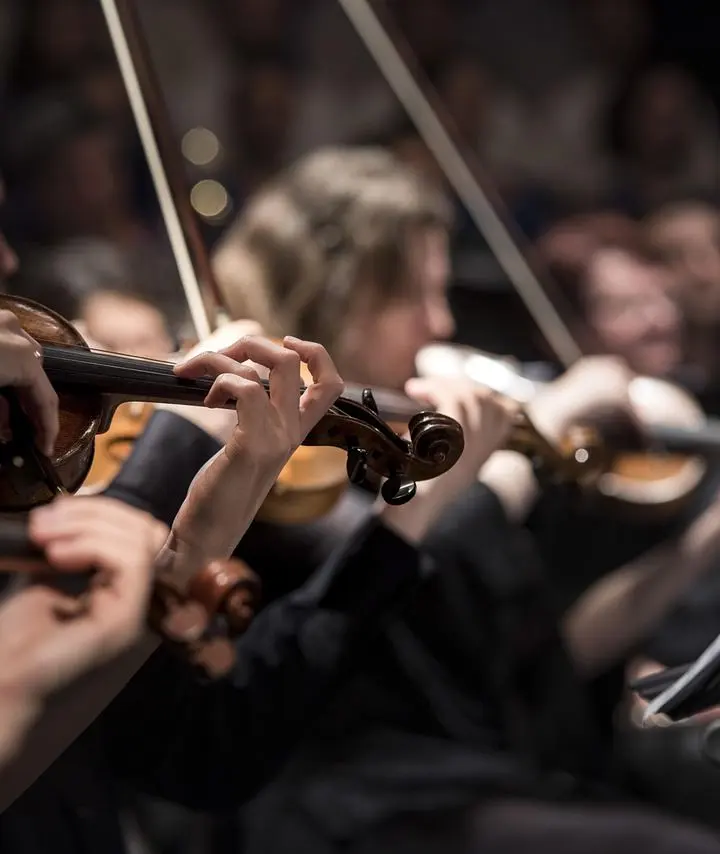
The string section is the largest group, which is why the orchestra looks so crowded with bows. The St. Louis guide puts it simply: there are many violins but only one tuba (SLSO). In one youth orchestra with 100 chairs, almost half go to violinists, according to the Wisconsin Youth Symphony Orchestras.
The violins are split in two. The 1st violins usually carry the melody, while the 2nd violins supply harmony and accompaniment, as the RemNote study guide puts it. Violas, cellos and double basses fill in the middle and low end of the sound.
Woodwinds and brass: parts written in pairs
Winds are far fewer in number than strings, and their parts are often written in pairs. The Beethoven model of the wind section is 2 flutes, 2 oboes, 2 clarinets, 2 bassoons, 4 horns and 2 trumpets, with trombones and tuba added only occasionally (RemNote).
The saxophone is a common mix-up. The same guide calls it an optional woodwind addition, not part of the core complement, so it is not a brass instrument and it appears only when a composer scores it.
Within each wind and brass group, players are matched to the range of the part. One youth-orchestra conductor explains that the 1st trumpet or 1st horn players must be secure in the upper register, while the 4th horn or 3rd trombone players need a rich, confident sound in the lower registers (WYSO).
Percussion, harp and keyboards
The percussion section is the most varied. In Britten’s guide the kettledrums (timpani) are joined by the bass drum, cymbals, tambourine, triangle, side drum and Chinese block, according to OnMusic of the World.
Harp and piano are where sources disagree. The RemNote guide lists the harp inside the string group, while the SLSO guide lists harp and piano on their own, outside the four families. Either way, the harp is optional: the same study guide says plainly that not every symphony requires one.
Orchestra sections: who sits where on stage?
Instruments of the same family sit together, and a seating chart shows each group in relation to the conductor. The St. Louis education pack includes a printable chart for exactly this purpose. Even so, seating is not an exact science, as one youth orchestra’s guidance puts it (WYSO), so treat any chart as a guide rather than a rule.
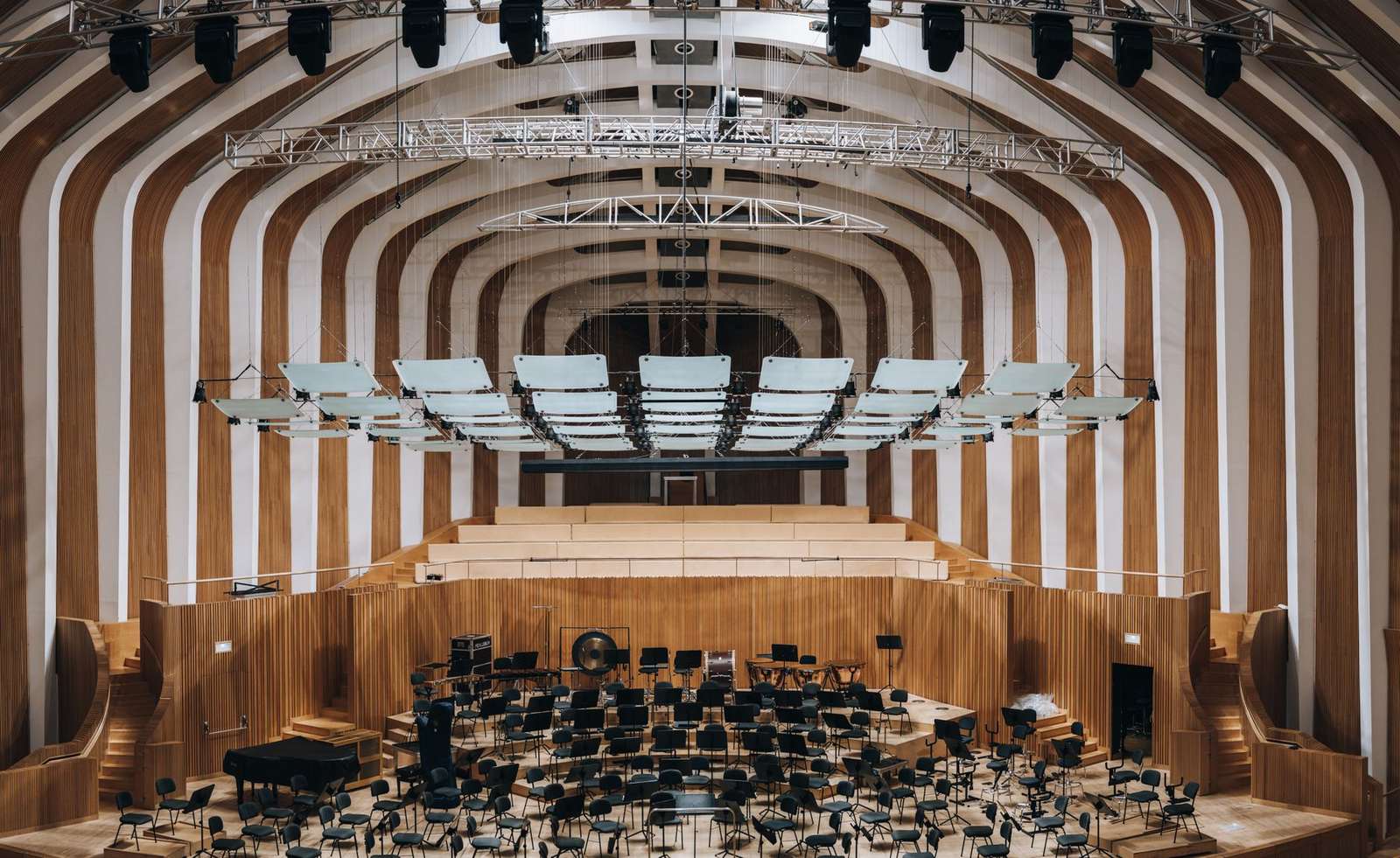
The same source says the conductor determines the seating and rotation within the sections. It also warns against a common myth: sitting at the front, back or middle of a section is not an indicator of the importance of a player’s voice.
In the professional world the rule is different, because you audition for whichever chair is open in your section. If the opening is for last chair in the violas or for 3rd trombone, that is the chair the winner gets.
Who leads each section?
Every section has a principal, who leads the group, plays solos and sets bowings and technique, according to the RemNote guide. The principal first violin is the concertmaster, who ranks after the conductor and leads tuning and bowings for all the strings.
That is why the tuning-up sound is so memorable. City Lit describes the oboe sounding concert A for everyone to tune to, while the RemNote guide adds that the concertmaster cues the orchestra.
The line-up has not always looked like this. The orchestra we know today has gradually evolved since around 1600, and by the late 1700s symphonies were a major form, as City Lit explains. To see how the sound changed over time, read about classical music periods. When one player steps out in front of the whole group, you are hearing the form explained in what is a concerto.
Frequently asked questions
How many musicians are in an orchestra?
Show answer
A full symphony orchestra is usually 70-100 musicians, and a traditional one may have more than 100 players. A chamber orchestra is smaller, at about 50 players or fewer (RemNote; OnMusic of the World).
Is the saxophone a brass instrument?
Show answer
No. The RemNote guide treats it as an optional woodwind addition, used only when a score calls for it.
Does sitting at the front mean you are the best player?
Show answer
Not necessarily. A youth orchestra conductor writes that front, middle or back placement does not show how important a player’s voice is, and that seating is arranged for the best balance of the group.
Does every orchestra have a harp?
Show answer
No. The RemNote study guide says a harp is optional, so it appears only in works that include a part for it.