Sitting through an opera in German or Italian can feel daunting. So, what are opera surtitles? They are translated lyrics projected above the stage, so you can follow the story as it happens.
Surtitles are one small part of a night out, and the live music section covers the rest of the evening.
| Item | Value |
|---|---|
| First live use | Elektra at the Canadian Opera Company, January 1983 |
| Introduced by | Lotfi Mansouri, then the company’s general director |
| Early slide limit | 40 characters per slide |
| Spread of projected titles | Over 100 companies within six months |
| Metropolitan Opera seatback titles | In place by 2002 |
| Vienna State Opera seatback choice | Six languages |
These figures come from NPR’s report on opera supertitles and Welsh National Opera’s history of surtitles. They can change, so check the source before you rely on them.
How surtitles work in the theatre
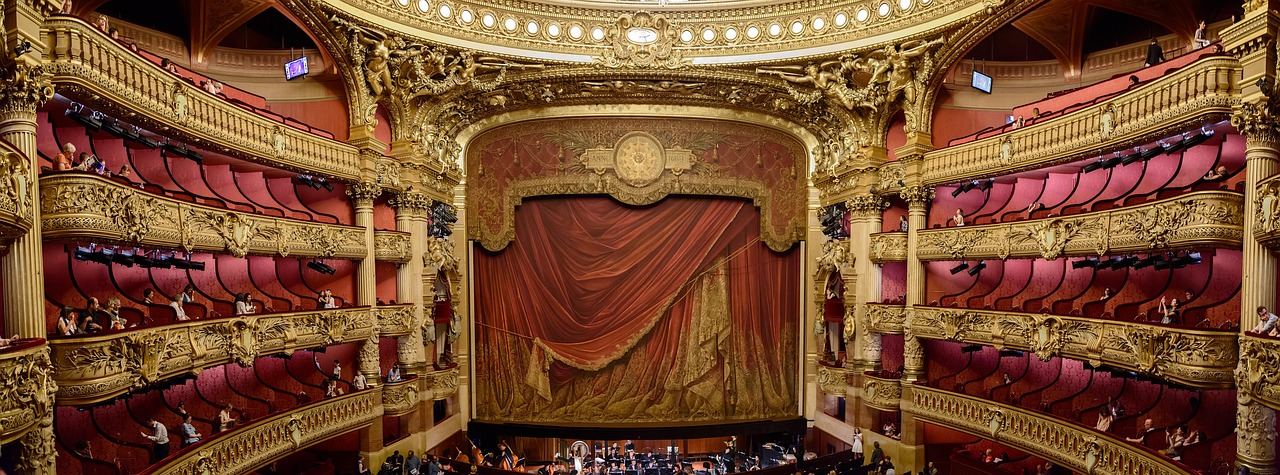
Surtitles are translated or transcribed lyrics shown on a screen while the singers perform. According to Wikipedia’s entry on surtitles, they are also known as supertitles, SurCaps and OpTrans. They are generally projected above the proscenium arch, though some theatres place them on either side of the stage.
The text is written in advance and cued live. At Welsh National Opera, the titles are prepared by the company’s dramaturg and operated by music staff who sit in a box in the theatre, following a queued score and clicking through each line. The company’s own history describes the process, and Wikipedia adds that an operator pushes a button at a marked point in the score when following the music.
The people running the titles are listening as closely as the singers and conductor. That is why a good title appears in step with the music, rather than a beat before or after it.
Where surtitles came from
In 1983, the Canadian Opera Company in Toronto tried a grand experiment. While the singers performed Elektra in German onstage, simultaneous translations in English were projected above the stage, as NPR reported. The idea came from the company’s leader, Lotfi Mansouri, and Welsh National Opera’s history credits him with introducing surtitles in that January 1983 production.
Mansouri hired Sonya Friedman to write the titles. According to Wikipedia, she had begun using supertitles for televised operas in the late 1970s.
Not everyone welcomed the idea. Mansouri recalled that critics called it the “plague from Canada”, as NPR’s report quotes him. Even so, the practice spread fast, with Friedman’s assistant Gunta Dreifelds saying that within six months over 100 companies were using some system of projected titles.
A few milestones from the sources show how the practice grew:
- 1983: Elektra in Toronto, with English titles above the stage (NPR).
- 2002: the Metropolitan Opera places its titles on seatbacks, a method later adopted by other houses (Welsh National Opera).
- 2005: English National Opera announces surtitles for performances in English, in response to public demand (Welsh National Opera).
The Metropolitan Opera held out for more than a decade. Friedman said its music director, James Levine, felt titles would compromise the stage, and he relented only after a patron paid for screens on the back of every seat, per NPR.
Why surtitles changed the opera-going experience
Before titles, an evening at a foreign-language opera needed homework. Marc Scorca of Opera America told NPR that he had to read a plot synopsis or even a libretto beforehand, and that the experience could be confusing and put many people off (NPR).
Jackie Vick of Intermountain Opera said titles broke down what people considered a language barrier. Friedman also noted that singers loved them, because they finally got a response from the audience to the tragedy and to the comedy.
Opinion was split from the start. In 1986 the editor of the British journal Opera, Rodney Miles, wrote that you go to the opera to listen and to watch, not to read, while a singer’s agent argued that titles made audiences more aware of the music drama (Welsh National Opera). Both views still make sense: titles are a trade-off between understanding and attention.
Is the translation word for word?
No. Friedman explained that you work out the character and the plot, then the meaning of what these people would want to say. She described herself as very free with the translations, but true to the sense of what the people are singing (NPR).
Space is part of the reason. Early projected slides held only 40 characters because the screen was so small, and even in the same report not every word of a libretto gets translated.
Technology has become simpler, too. NPR describes modern supertitles as basically PowerPoint presentations that take only two people to run, and Wikipedia notes that most companies now use video projectors and computers rather than slides.
Other ways to read the words
A screen above the stage is not the only option. Some houses have developed personal systems for people who want the text without everyone seeing it:
- Seatback screens: the Vienna State Opera lets each person choose from six languages, according to Welsh National Opera. Wikipedia says such electronic libretto systems also let patrons switch the text off.
- Smart glasses: a company called Panthea ran a larger pilot of multilingual surtitles on smartglasses at the Festival d’Avignon 2017, after a successful test run in 2015 (Wikipedia).
- Repeater screens: Welsh National Opera uses extra screens in theatres where restricted vision would stop people seeing the main titles clearly (Welsh National Opera).
The reason for these systems is simple. As Wikipedia puts it, surtitles can be a distraction, focusing attention on the titles instead of the stage.
Tips for following the story
You do not need to read every line to enjoy the evening. These steps keep the stage in view:
- Read the plot summary before the curtain rises, so the titles confirm what you already expect.
- Glance up when a scene changes or a character says something important, then return your eyes to the singers.
- Choose a seat with a clear view of the screen, and check whether the house offers seatback or repeater screens.
- Let the music carry the mood when a title is brief or missing.
Planning helps, and a look at how long is an opera will tell you what kind of evening to expect. For the printed side of preparation, the guide on how to read a concert program is a good place to start.
Frequently asked questions
Are surtitles and supertitles the same thing?
Show answer
Yes, the terms are used for the same practice. Wikipedia notes that the word Surtitle is a trademark of the Canadian Opera Company, which is one reason both spellings are common (Wikipedia).
Do operas sung in English have surtitles?
Show answer
Often they do. English National Opera announced in 2005 that it was introducing surtitles in response to public demand, arguing that few people could hear the words clearly in such a large theatre (Welsh National Opera).
Can I turn surtitles off?
Show answer
Not with a screen above the stage, which everyone sees. With electronic libretto systems on individual seatbacks, patrons can view a translation or switch it off (Wikipedia).
Who writes and runs the titles?
Show answer
It varies by company. At Welsh National Opera, the dramaturg prepares the titles and music staff operate them from a box in the theatre (Welsh National Opera).